


Never before has so much capital flowed into the global tech sector. Never before have so few recent graduates entered it. The paradox is somewhat cruel: the class of 2026, the first generation to have completed their studies with ChatGPT as a secondary option, is arriving in a market where AI has already taken its place.
The figures confirm this intuition: a 50% drop in hiring of recent graduates in Big Tech over three years, and two out of three French employers planning to reduce their entry-level positions by 2028. No dramatic restructuring plans, no bombshell announcements. Just a discreet, methodical freeze on junior hiring.
The airlock closes silently.
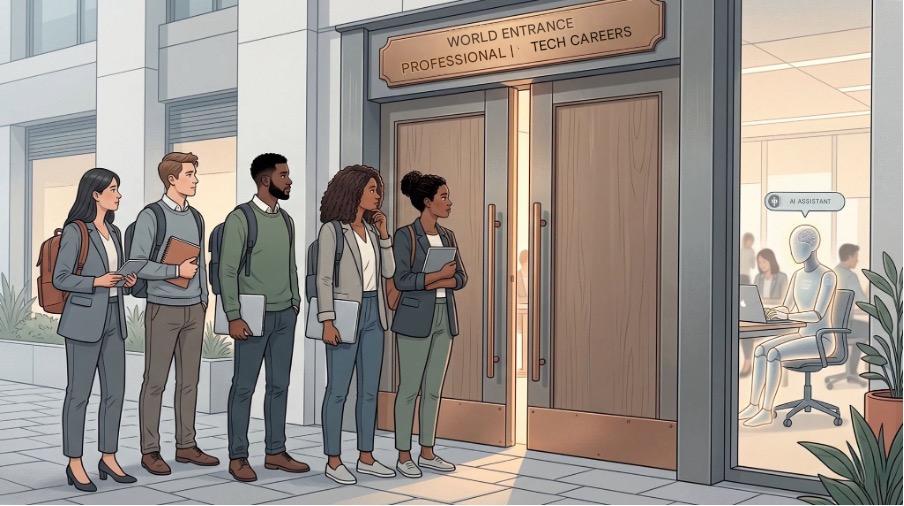
The figures come from everywhere and say the same thing. The IDC/Deel survey from the end of 2025 indicates that 67% of French employers intend to reduce their junior recruitment within three years, and that 83% anticipate job cuts related to AI .
In the global Big Tech sector, Developpez.com estimates a 50% drop in hiring of recent graduates over three years. Conversely, the Stack Overflow Developer Survey 2025 shows that 84% of developers now use an AI assistant on a daily basis .
Gartner, for its part, predicts that 40% of enterprise applications will integrate an AI agent by the end of 2026, compared to just 5% by mid-2025. Three curves, one single trajectory.
What AI nibbles away at first
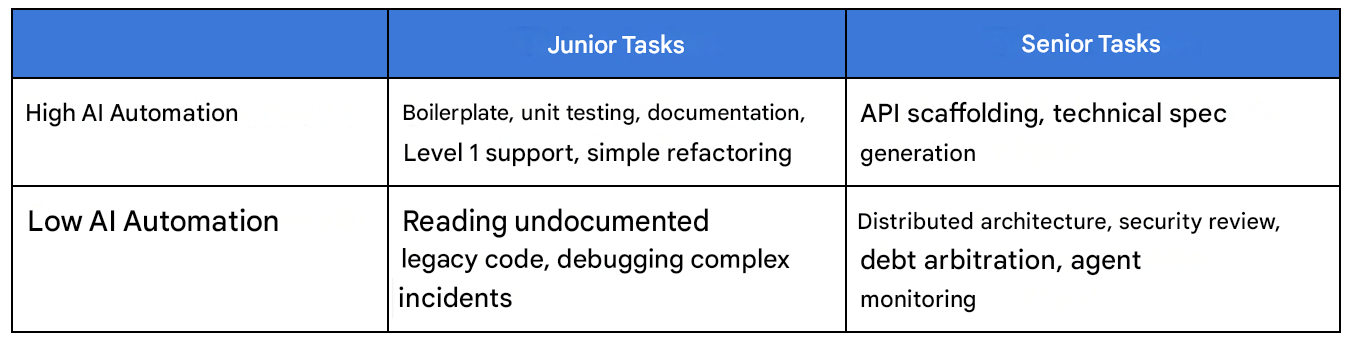
The scope of nibbling is no longer mysterious. Automated testing, bug fixing, boilerplate generation, documentation, N1 support tickets, simple refactoring, application maintenance — all these tasks used to occupy the early years of a developer, and are now delivered by an AI assistant on an assembly line .
The tooling has been industrialized in less than three years: Copilot in the IDE , Cursor for agentic workflows, Claude Code for command line, Gemini for multi-step sequences…
In reality, what seemed like experimentation yesterday has become the default stack. At this rate, asking a junior developer to write the thousandth CRUD operation of their career is almost a conservative, pedagogical gesture.
A global wave, but not a French tidal wave
The effect is not evenly distributed. At the Indian Institute of Information Technology in Jabalpur, less than 25% of the class of 2026 had signed a job offer six months before graduation. There, they’re talking about a jobpocalypse —the term is circulating from Kenya to Dubai, from Bangalore to Shenzhen. In the United States, the “ChatGPT” cohort is directly competing with agents capable of managing a complete workflow without intermediate supervision.
France is absorbing the shock more slowly. There’s no sudden purge, but rather a gradual tightening of junior hiring. French tech isn’t India, but it’s keeping pace.
Why AI bites first among beginners

From the IT department’s perspective, the calculation has shifted.
The arbitration process can be summarized in two lines on a corner of an Excel spreadsheet. An AI agent earns around a few hundred euros per month per seat.
No overhead, no holidays, no learning curve… A junior developer , on the other hand, requires an annual cost of around 50,000 euros, plus the senior time tied up to supervise him, often 15 to 20% of the team’s bandwidth.
The calculation became trivial as soon as the agent delivered a usable output . Eric Bahn, a partner at Hustle Fund, summarized the shift for Tech Crunch : 2026 is the year AI stops making humans more productive and starts automating work itself . Should we see this as a temporary effect? Probably not, as long as the OPEX pressure remains at its current level.
Junior work, the ideal playing field for an LLM
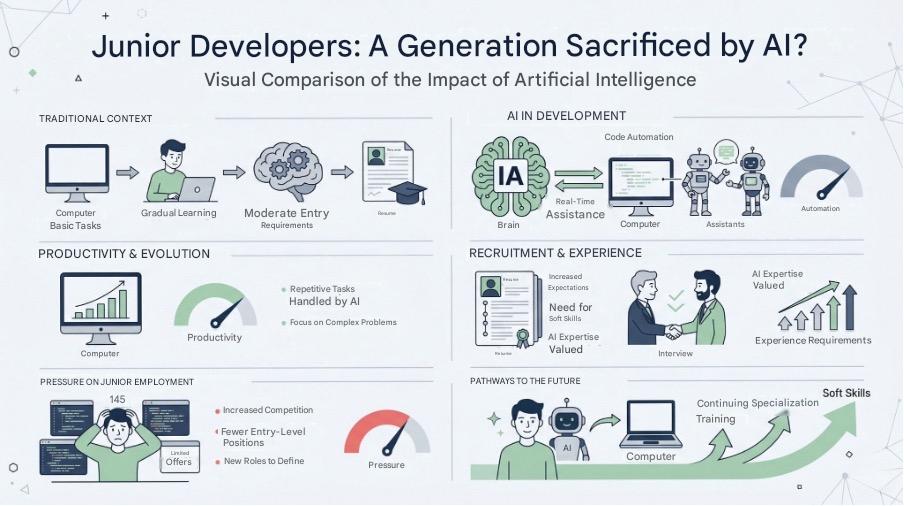
The very nature of entry-level work explains the selectivity of the replacement. The tasks assigned to a junior are structured, repetitive, framed by stable specifications, with low architectural stakes.
This is precisely the comfort zone of LLM . Conversely, technical debt arbitration, distributed system design, application security review, and product-tech coordination require a contextual understanding that models do not stabilize.
A study (CodeRabbit) notes that nearly 40% of the gross productivity gains from AI are reabsorbed downstream by error correction . The cost exists; it has simply shifted.
Boilerplate learning, on the verge of extinction
The industry eliminates repetitive tasks without replacing the learning mechanism they provided. Boilerplate, bug tickets, and N1 support did not just produce deliverables—they built an intuition for code, a debugging reflex, and an understanding of complex systems.
A senior employee’s value lies in years spent making poor architectural choices , being dragged out of bed at 2 a.m. by a production incident, and accumulating a database of recognizable error patterns. This database can’t be downloaded. Without the basic skills, the next level becomes inaccessible, and the promise of automatic skills development is mostly just HR hype.
How to regain control?

Skills that cannot be automated
The line between execution and supervision is now clearly drawn. Everything related to scoping – understanding a business need, translating a production constraint into a technical requirement, validating an AI output, arbitrating debt – concentrates the value .
On the purely technical side, the list is becoming clearer: software architecture, distributed systems design, application security, observability, MLOps , advanced data engineering, industrial prompt engineering, automated workflow auditing…
Soufiane Keli, tech lead interviewed by JDN, has probably found the image that will stick: “AI is an additional junior collaborator, not very intelligent but extremely productive.”
The hierarchy is reversed; true human value now lies in framing, validation, and pedagogy. In short, in everything the employee doesn’t deliver.
The new entrance doors, narrower but very real
The market is not contracting uniformly. Thus, new junior roles are emerging around the supervision of agents and the industrialization of AI workflows : AI-augmented developer , prompt engineer , AI ops , fine-tuning engineer , data quality analyst .
IBM, for example, is announcing that it will triple its junior hires in the United States by 2026, but for radically different roles, focused on piloting and supervising AI agents, not direct execution.
From the employer’s perspective: enhanced tandem rather than zero junior
The “zero junior” strategy is tempting in the short term. But it sets a five-year time bomb. Without an incoming cohort, the pool of senior staff will inevitably dry up.
The model that is gradually becoming established among mature teams is based on a triad of junior + senior + AI agent:
- The junior pilots the agent.
- The senior member approves the architectural choices.
- The agent absorbs the mechanical load.
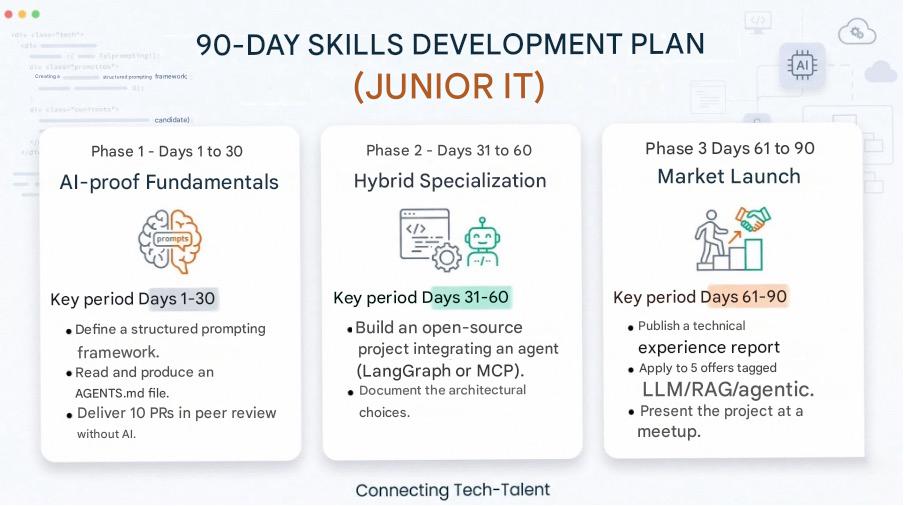
Three practices can structure this system. First, AGENTS md files , an open format that frames AI production according to the team’s standards. Second, periodic coding sessions without AI to rebuild intuition. Finally, a strong return to the principles of Software Craftsmanship: clean code, TDD, and human readability.
Are junior developers being sacrificed by AI?
AI hasn’t killed tech jobs. It’s killed the way people get into tech jobs. That’s a crucial distinction! The sector is now operating on two fronts: in the short term, a generation of graduates is facing a market that doesn’t know where to place them; in the medium term, the same sector is creating a shortage of experienced professionals that the growth of tech tools alone won’t be enough to fill.
The bottom line needs to be rebuilt by the developers themselves, who are shifting from execution to oversight, and by recruiters, who must start training again, but in a different way. The 2026 snapshot isn’t a definitive verdict. It’s just the first image of a market in the process of rewriting itself, and there’s still room within the frame, provided we look at it from the right angle.