


Deploying a new version to production without service interruption is one of the major challenges facing modern IT teams. Blue-green deployment provides a practical solution to this problem. This deployment method is increasingly appealing to DevOps professionals . It’s based on a clever principle: running two identical production environments side-by-side and switching between them in seconds. Here’s an overview of the benefits, constraints, and concrete use cases.
What exactly is the blue green deployment?
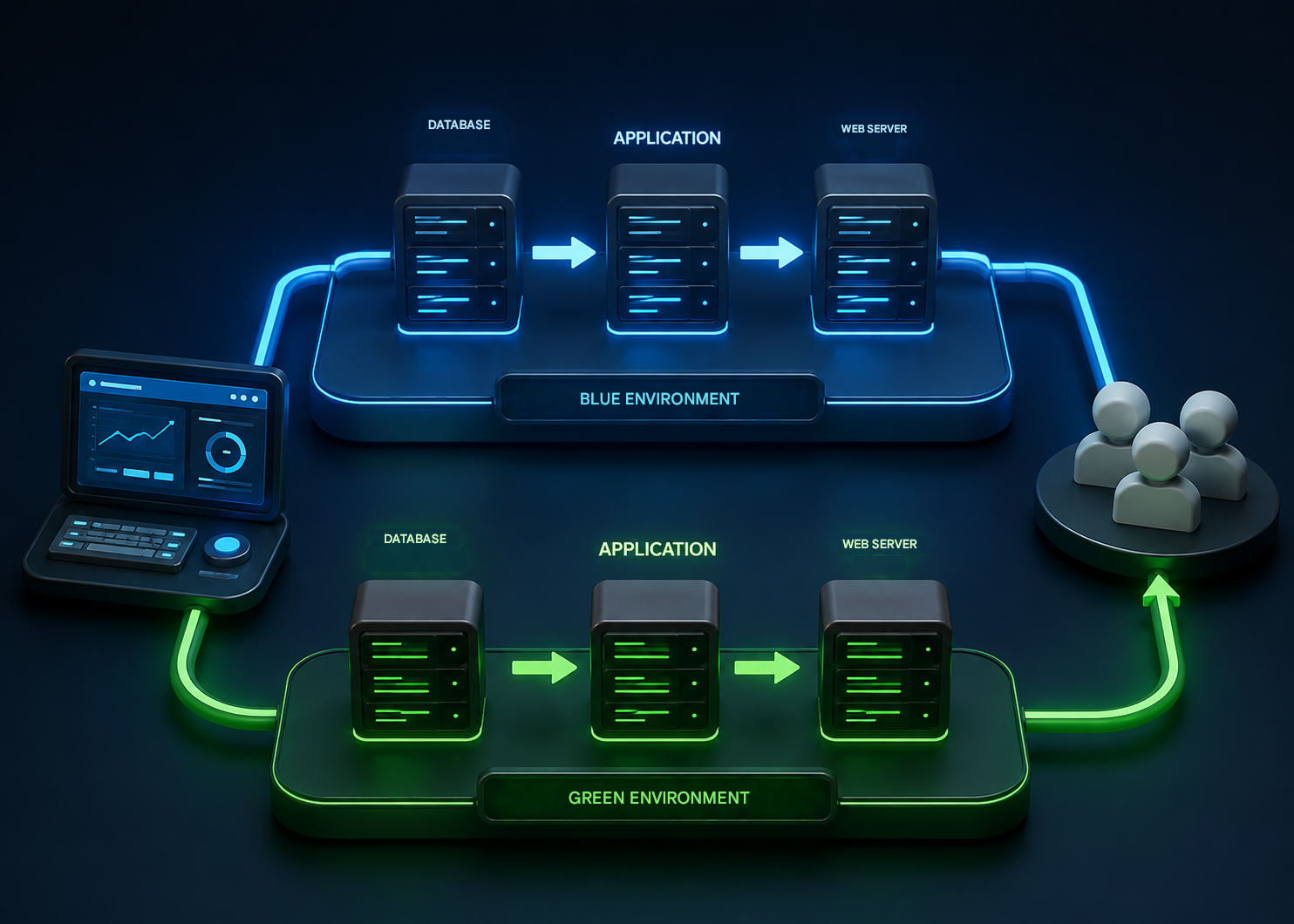
Blue-green deployment relies on a simple mechanism. Two strictly equivalent production environments coexist in parallel. One (the blue environment) receives user traffic. The other (the green environment) hosts the new version of the application. Once this version is validated, traffic switches from the blue environment to the green environment via a load balancer.
The approach is fully in line with DevOps culture. The concept appeared in 2010 in the book Continuous Delivery by Jez Humble and David Farley, shortly after the emergence of the DevOps movement initiated by Patrick Debois in 2009. This approach has a name in the technical jargon: Zero Downtime Deployment (ZDD).
The goal can be summed up in a few words: to deploy a new application version without service interruption, while retaining the ability to instantly revert to the previous version if an incident occurs.
Why is blue green deployment appealing to DevOps professionals?
For engineers working in DevOps , this method offers several concrete operational advantages.
Near-total continuity of service
The switchover between the two environments takes place in seconds via a routing change. The operation remains invisible to end users.
A simplified rollback
If the new version causes problems, simply redirect traffic to the blue environment to revert to the previous state. The rollback process takes a few seconds instead of several minutes or hours.
Early detection of anomalies
The green environment can be tested in real-world conditions before the switchover. Teams validate application behavior on an infrastructure equivalent to production, using tools such as Selenium or JUnit to automate testing.
Enhanced collaboration between Dev and Ops
The method promotes communication between developers and system administrators, which directly aligns with the DevOps philosophy.
Limitations to be aware of before starting

This method also presents several constraints that should be evaluated before integrating it into a deployment pipeline.
Infrastructure costs doubled
Maintaining two identical production environments requires twice the server, network, and storage resources. For organizations with tight budgets, this duplication can become a hindrance.
Database management remains a delicate matter.
Schema changes or data migrations between versions require careful planning. A new application version may introduce changes incompatible with the existing database.
A high level of automation is required.
The effectiveness of this approach relies on robust orchestration tools, such as Kubernetes, Docker, or managed cloud services (AWS, Azure). Teams with limited automation experience will struggle to leverage it.
A need for advanced monitoring
Without detailed observability of both environments, some anomalies may go unnoticed during the switchover.
Concrete use case: the methodology detailed by Free-Work

The article published by Free-Work, Blue/Green DevOps: an effective approach for flawless deployments , details the concrete steps to set up a Blue/Green environment in a project context.
The setup begins with the deployment of two identical sets of servers, in terms of configuration and capacity, hosted on virtual machines, containers, or cloud instances. Load balancers and reverse proxies orchestrate the traffic failover and offer advanced features (SSL optimization, caching, compression).
Next comes the fine-grained management of databases, which involves using versioned and automated migration scripts, tested beforehand on copies of the production database. Tools such as Ansible or Puppet allow for the automation and validation of configuration changes between the blue and green environments.
In addition, robust monitoring via tools such as ELK Stack, Grafana or Prometheus allows for the collection and visualization of real-time data on performance, errors and application events.
In the industry, several major digital players rely on this method. Amazon Web Services natively offers this approach through Amazon ECS and Amazon RDS, which allow DevOps teams to create a green environment replicating production before applying changes. Netflix, for its part, uses Spinnaker, its open-source continuous deployment platform, to orchestrate its failovers across thousands of microservices.
In what cases should blue green deployment be preferred?
This method proves highly relevant in several situations:
- Critical applications where downtime has a high cost (e-commerce, banking services, SaaS platforms)
- Cloud-native architectures already containerized (Kubernetes, Docker)
- Teams with experience in CI/CD practices and automation
- Cases where a rapid rollback is a business requirement
For teams still in the building phase of their CI/CD pipeline, blue green deployment can serve as an entry point to gain maturity before exploring more refined methods (canary deployment, rolling update).
A skill highly valued in the DevOps job market

Knowledge of modern deployment strategies is now a key expectation for recruiters seeking DevOps roles. According to Free-Work surveys, DevOps professionals remain in high demand , with daily rates reflecting their technical expertise. DevOps engineers operate in a demanding environment where knowledge of orchestration tools and advanced deployment patterns opens up exciting career opportunities.
For freelancers and employees in the sector, knowing how to implement a blue green deployment represents a real asset for positioning themselves on infrastructure or cloud migration projects.
FAQ
What is the difference between blue green deployment and canary deployment?
Blue-green deployment migrates all traffic from one environment to another in a single operation. Canary deployment, on the other hand, deploys the new version to a subset of servers and gradually redirects traffic to those servers. Canary deployment offers more granular deployment but requires more detailed monitoring and a more complex routing logic to implement.
Is blue green deployment suitable for all businesses?
Not necessarily. This method requires a replicated infrastructure and mature automation tools. Small organizations with limited resources may find the infrastructure cost too high. For applications with high availability requirements (e-commerce, finance, SaaS platforms), the investment is fully justified.
What tools should be used to implement a blue-green deployment?
Several categories of tools are involved. Container orchestration relies on Kubernetes or Docker Swarm. Traffic routing uses NGINX, HAProxy, or cloud load balancers (AWS ELB, Azure Load Balancer). Configuration management is based on Ansible, Puppet, or Chef. Monitoring is organized around Prometheus, Grafana, or ELK Stack. Cloud providers now offer managed solutions that simplify deployment, such as Amazon ECS and Amazon RDS.
How to manage the database during a blue-green deployment?
This is the most delicate point. Best practices recommend prioritizing backward-compatible schemas, using versioned and pre-tested migration scripts, and implementing data synchronization between environments. Some teams opt for a shared database between blue and green environments, while others prefer dedicated databases with synchronization mechanisms.
Is blue-green deployment one of the skills expected in the DevOps profession?
Yes, increasingly so. Advanced deployment strategies (blue-green, canary, rolling) are now part of the expected technical foundation for experienced DevOps projects. To learn more about these topics, see the DevOps training guide and the top DevOps tools for 2026 .