


What does an IT architecture look like when AI drives some of the technical decisions? What models will replace our current tools when collaborative agents, sovereign clouds, or AI-native platforms dominate projects?
These questions often arise in teams that seek to anticipate rather than react. The Gartner 2026 prospective study provides a structured perspective on these possible trajectories.
The 3 strategic figures who will guide Tech innovation in 2026?
The IT ecosystem is going through a decisive moment: AI is accelerating everywhere, reorganizing priorities and forcing companies to reassess their technical choices.
Gartner observes this dynamic and, at the Orlando Symposium/Xpo, unveils a structured reading of the movements that are reshaping digital competition.
The firm groups its trends into three thematic figures that embody three ways of confronting the ongoing transformation.
The Architect – Building a robust, scalable, and AI-compatible digital foundation
The figure of the Architect reflects a clear ambition: to consolidate the digital foundations in order to support AI-native development platforms or intensive computing environments dedicated to AI.
Organizations that adopt this approach prioritize the security, scalability, and adaptability of their infrastructures, serving an architecture capable of absorbing ever-increasing loads.
The Synthesist – Combining technologies to unlock new value drivers
The Synthesizer illustrates another logic: combining multiple technologies to generate tangible operational gains .
This figure highlights approaches such as multi-agent systems or specialized language models, which transform workflows and create new value loops for teams.
The Vanguard – Strengthening trust, governance and security in an unstable landscape
The Avant-garde, finally, focuses on risk management .
It brings together strategies that protect the organization through proactive cybersecurity , digital traceability and AI security platforms, in order to ensure reliable governance despite the increasing complexity of digital environments.
1️⃣ Modernizing digital foundations: the Architect’s stance
Organizations that adopt the Architect’s approach will undertake a profound transformation of their technical foundation. They will strengthen their platforms, harmonize their infrastructures, and build a more favorable environment for advanced AI applications.
AI-native development platforms
AI-native development environments are radically changing the software factory.
Specialized agents will generate code in a single burst, manage entire pipelines, and accelerate tasks that currently require multiple technical roles.
Approaches like “one-shot code” or ” vibe coding ” are already redefining the pace of sprints.
This transformation is restructuring engineering organizations. “Tiny teams” will emerge, more autonomous, more cross-functional, capable of operating on expanded scopes.
The line between build and buy will also evolve: AI will reduce the marginal cost of internal production and encourage CIOs to reassess architectural choices deemed fixed.
The metrics projected by Gartner illustrate the scale of the phenomenon:
- 80% of engineering teams will operate in micro-teams by 2030.
- 40% of new applications will rely on AI-native environments.
AI supercomputing platforms
The other lever concerns raw power. AI supercomputing platforms will unify HPC, GPUs, ASICs, neuromorphic architectures and quantum technologies within hybrid stacks.
They will support workloads that were previously inaccessible: training giant models, multimodal execution, high-speed simulation, distributed optimization…
CIOs will see this as a way to expand their capabilities without multiplying heterogeneous environments.
Furthermore, hybrid cloud will become the norm, as it will combine flexibility, hardware acceleration, and finer data governance .
Gartner anticipates a fivefold increase in adoption of hybrid computing by 2028, driven by more than twenty vendors capable of delivering unified platforms.
Confidential computing
Third focus: the protection of data in use.
Confidential computing will become a cornerstone of digital sovereignty. Hardware enclaves (TEEs) will isolate sensitive processing, preserve models, and protect internal flows against latent threats.
AI architectures, which are highly exposed to the risks of data leakage or interception of model weights, will gain in robustness thanks to these isolation mechanisms.
And this evolution will become essential in a regulatory context that will become stricter and in which proof of compliance will weigh more and more heavily in architectural decisions.
According to Gartner, 75% of processing operations performed in untrusted environments will benefit from encryption or advanced isolation by 2029 .
2️⃣ Orchestrating new intelligent ecosystems: the Synthesizer’s stance
Multiagent Systems (MAS)
Multi-agent systems will shape a new mode of execution.
They will bring together specialist agents capable of cooperating on complex tasks , each operating within a specific scope: extraction, analysis, action, verification.
Distributed architectures will emerge, often described as an “Internet of Agents” where components communicate without depending on a single model.
This approach unlocks greater modularity and scalability. IT teams will assemble their agents as intelligent microservices , with the ability to extend or replace a capacity without disrupting the whole.
Multi-platform integration will become a major asset, as agents will interact with heterogeneous APIs, legacy applications, or cloud environments.
Gartner’s projections reinforce this trend:
- +1,445% increase in interest for MAS between 2024 and 2025.
- 70% of multi-agent systems will specialize by 2027.
Domain-Specific Language Models (DSLMs)
The second orchestration method will rely on specialized models.
DSLMs will be trained on industry-specific datasets—finance, healthcare, manufacturing, HR—to achieve a level of precision unattainable by general-purpose LLMs. This specialization will improve compliance , particularly in regulated sectors where ambiguity creates legal risk.
These models will also reduce costs. A DSLM will likely require less power to achieve a high level of performance in a business use case, which will encourage companies to favor more compact models, run on-premises or on devices.
The figures announced by Gartner support this:
- 30% of GenAI models will become specialized.
- 60% of AI workloads will run on-prem or on-device.
DSLM will therefore become a natural tool for teams seeking precision, speed and efficiency.
Physical AI

Third modality: intelligence that will emerge from the cloud to become part of the physical world.
Physical AI will power robots, drones, vehicles, and autonomous devices capable of operating in unstable or partially controlled environments. Organizations will see it as a way to automate critical operations : logistics, maintenance, industrial inspection, and perimeter security.
Tasks previously distributed across multiple teams will shift to physical agents linked to embedded models. Response times will become shorter, and some operations will be performed without direct supervision.
Gartner estimates here that 80% of warehouses will operate with a significantly higher rate of automation by 2028 , driven by this wave of Physical AI.
3️⃣ Strengthening governance, security and trust: the Vanguard stance
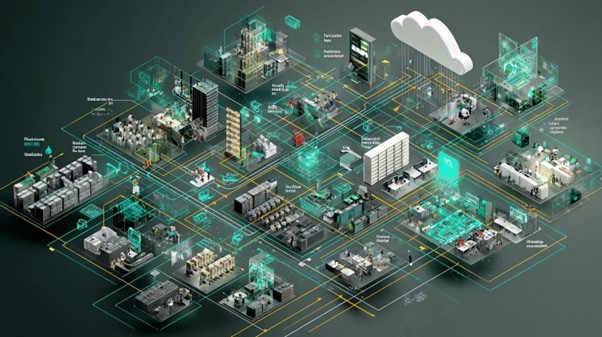
When AI is integrated into every component of the IS, governance and security will become central issues.
Proactive cybersecurity
Proactive cybersecurity already represents a clear break from traditional approaches. In the near future, it will rely more heavily on predictive detection, active decoys, dynamic obfuscation, and defensive mechanisms capable of intervening before a vulnerability is exploited.
SOCs will adopt analysis models capable of anticipating attack chains and not just responding to an incident.
This transition will change the relationship to risk; companies will adopt a proactive posture, with a reduced scope of attack and an almost zero reaction time.
Gartner predicts that 50% of the cybersecurity budget could be directed towards these proactive approaches by 2030, driven by an explosion in the number of vulnerabilities detected, which will exceed one million per year.
Digital provenance
Second pillar: digital traceability. Organizations will have to prove the origin of their data, models, libraries or software components.
Mechanisms such as SBOM, ML-BOM, watermarking , and cryptographic attestation will structure this traceability.
This requirement will become a bulwark against deepfakes, contaminated models, compromised software chains or infiltrated datasets.
Regulatory pressure – with the AI Act at the forefront – will accelerate this adoption and make these requirements indispensable in any industrial context.
AI Security Platforms (AISPs)

AI security platforms constitute the third pillar. They will unify abuse detection, usage control, prompt analysis, automatic model evaluation, and cross-functional monitoring of all AI workflows.
They will become an indispensable module for any company that automates part of its operations via agents or DSLMs .
The main challenge will lie in managing internal abuse. Gartner anticipates that 80% of AI incidents will stem from misuse or dangerous practices within the organization itself.
“Geopatriation”
The final lever is geopatriation (or relocation of sensitive workloads). This involves relocating sensitive workloads to sovereign environments, on-premises or in colocation, in order to reduce geopolitical risks.
This strategy will address a growing concern: excessive dependence on hyperscalers, issues of legal extraterritoriality, exposure to international tensions.
According to Gartner, 75% of companies will have repatriated a significant portion of their workloads by 2030 , a sign of a sustainable transition towards more autonomous architectures.