


It often starts with a small detail. A dashboard that loops endlessly for no reason. A data script that’s never cleaned up. Then come the questions: Why is it so slow? Why does it cost so much? Why so much infrastructure for so little value? This is where Green IT comes in, not as yet another CSR mandate, but as a cultural shift.
A culture that is disrupting habits, processes, and professions. And which, in 2026, will seriously redraw the map of IT skills?
Why can’t companies delegate this issue anymore?

Green IT is no longer just an ethical gimmick outsourced to tick a box. By 2026, the very foundations of digital activity are faltering: regulatory constraints, budgetary shocks, increased social expectations… the issue permeates all levels of the organization.
Regulatory pressures: no more greenwashing, time for verifiable reports
The era of empty charters and self-proclaimed labels is over. European texts (CSRD, DPEF, Green Taxonomy ) now mandate precise management of digital footprints.
Digital technology is officially entering the realm of non-financial reporting . It must adhere to a logic of proof, not goodwill.
What does this imply?
- Quantify the GHG emissions of infrastructure, software, and services.
- Trace IT purchases according to sustainability criteria (life cycle, repairability, origin).
- Applying responsible digital practices in public tenders.
Internally, this means one thing: it’s no longer possible to delegate solely to the IT department or the CSR department . Coordination becomes cross-functional, ongoing, and structured.
Economic pressures: the era of unlimited resources is coming to an end
Skyrocketing cloud bills. Unavoidable storage costs. Increasingly resource-intensive AI models, without a proportional performance gain.
By 2026, economic calculations will align with the logic of austerity . Companies must:
- Reduce the infrastructure areas required for each feature.
- Prioritize the data to be kept, the models to be trained, and the flows to be activated.
- Rethinking the user experience under budgetary AND environmental constraints.
We no longer scale at all costs. We make trade-offs. We choose. This shift puts the technical and economic decision back at the heart of IT design.
Social pressures: tech talent wants meaning, not promises
The meaning of tech work is evolving. And fast.
Nowadays, IT talent favours projects aligned with real climate challenges, shuns organisations that disguise their impact and questions the sustainability of technical choices from onboarding.
The result: employer branding also hinges on simplicity . This is a new frontier in IT recruitment.
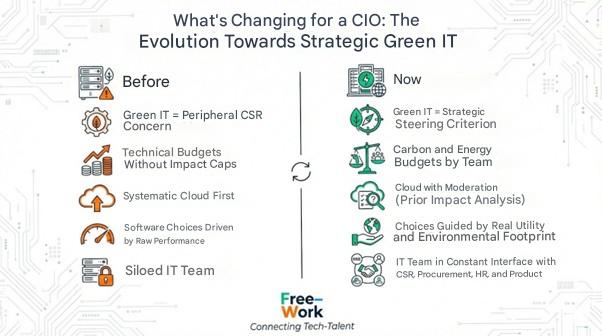
Which Green IT jobs are expected to grow in 2026?
Simplicity by design: these roles are designed to minimize impact from the outset.

Green IT Manager / Responsible Digital Manager
This role ensures the environmental governance of digital activities . It coordinates audits, develops indicators, and manages the sustainability roadmaps. It collaborates with IT teams, as well as purchasing, CSR, and production.
Eco-designer of digital services
Coming from the world of design, development or product management, he structures the design of interfaces and functionalities according to eco-design standards.
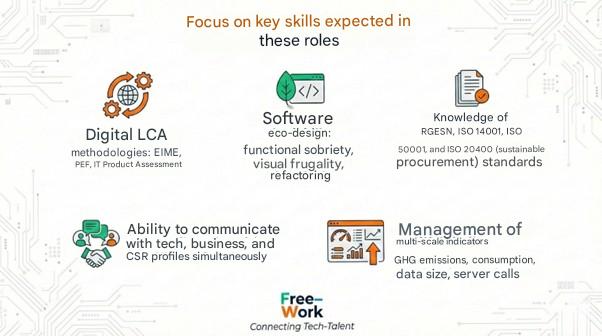
It applies the RGESN (General Reference Framework for Eco-design of Digital Services), arbitrates functional utility and ensures overall sustainability.
Digital LCA Consultant / IT Impact Analyst
As a Life Cycle Assessment (LCA) specialist , he measures environmental impacts from end to end: manufacturing, use, and end of life. He considers the interplay of software, hardware, and network dimensions. He translates physical impacts into strategic IT decisions .
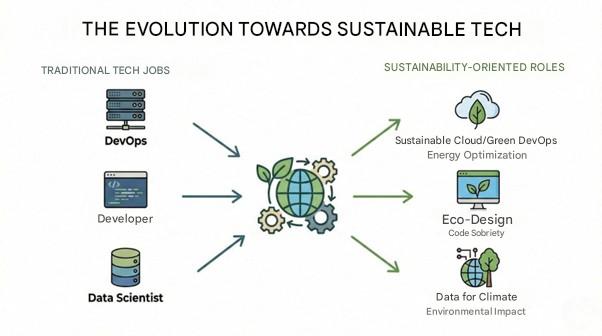
Traditional IT jobs that are changing in scale
Eco-responsible developer: code less, code better
No more piling up libraries or loading everything client-side! The developer of 2026 treats each line as a decision . They query dependencies, streamline network calls, reduce unnecessary animations… They document technical choices based on both environmental impact and functional performance.
On a daily basis, he:
- Favor simple components and lightweight frameworks.
- Reduces technical debt by anticipating refactorings,
- Avoid over-specification and rebound effects in UX/UI.
- Actively collaborates with the eco-designer and the IT architect.
Lean IT Architect: Structuring under constraints
This is one of the most strategic positions in the transition.
The IT architect of 2026 thinks in terms of carbon budget . They no longer seek only to maximize resilience or scalability, but to optimize the value chain while minimizing impact .
He designs decoupled, resource-efficient architectures, limits redundant calls and verbose systems, and integrates footprint indicators into his POCs and technical benchmarks.
Ops & SRE “sobriety-aware”
Long measured solely by stability, Ops and SRE now add energy efficiency to their metrics.
They monitor unnecessary load spikes, disable inactive modules, and adopt a “use when needed” logic .
Their scope of action notably covers:
- The streamlining of development and staging environments,
- Automating the shutdown of VMs/containers outside of their useful operating hours,
- The implementation of hybrid dashboards: performance + footprint.
Governing, arbitrating, steering: the functions that orchestrate sobriety
Beyond the technical aspects, digital sobriety relies on cross-functional roles capable of framing projects, setting limits, and enforcing them without slowing down innovation .
Head of Sustainable Digital Strategy
It defines the overall directions. It translates CSR objectives into concrete commitments for the IT department, product, purchasing, and HR.
He arbitrates priorities, steers the Green IT roadmap and embodies the long-term vision .
Product Owner “sobriety & value in use”
His role? To prioritize with restraint . He no longer simply optimizes the backlog; he challenges each business request on its real value, its actual use, its technical and environmental cost.
IT Buyer in Charge
In line with sustainable procurement practices, environmental criteria are applied from the sourcing phase onward. Furthermore, the buyer evaluates equipment based on its life cycle, repairability, and actual energy consumption.
It demands strong commitments from suppliers regarding energy efficiency, and includes them in contracts .
Digital Compliance & Reporting Manager
This system consolidates impact data from across the company. It ensures the consistency of indicators published in extra-financial reports (CSRD, ESG, labels, etc.).
Finally, it monitors upcoming standards and regulations, and prepares the company to respond to them without waiting until the last minute .
Green IT, AI, data, cloud: what remains of sobriety?

Digital technology is accelerating on all fronts. Generative AI , massive data volumes, hyperconnectivity of objects, immersive platforms… every technological promise seems to push back the boundaries.
But these energy-intensive innovations directly clash with ambitions for energy efficiency. Hence the troubling question: can we still be ” Green IT ” in a rapidly accelerating digital world?
AI sobriety: persistent myth, possible compromise or new specialty?
There is increasing talk of more streamlined models , architecture compression, and inference optimization.
But in reality, the generative AIs of 2026 consume massive amounts of resources , often without proportional return.
- Training an LLM model: several hundred MWh.
- Keeping it up to date: a high-density infrastructure.
- Using it continuously: an energy drain, for answers that are sometimes unnecessary.
However, a new field is emerging: frugal AI .
Its principles:
- Fine-tuning instead of a complete retraining
- Distillation of models to reduce their weight,
- Optimizing prompts to limit unnecessary calls,
- Selecting tasks to automate based on their actual added value.
In fact, responsible AI engineering is becoming a specialty in its own right, which does not seek to slow down AI… but to contain it.
Cloud, edge, data: real levers or permanent rebound effect?
Migrating to the cloud has long been presented as an environmentally sound choice. So has consuming data via edge computing. But the rebound effect is everywhere: what we gain in optimization, we lose in exponentially increased usage.
The cloud pools resources, but creates an illusion of abundance. It encourages constant, often unjustified, scalability and masks physical externalities behind a layer of abstraction.
For its part, the edge avoids back-and-forth trips to the cloud, but multiplies local micro-servers, often poorly controlled.
As for data, it fuels business value, but accumulates without any reasoned management…
Therefore, frugality becomes an art of technical restraint . A matter of governance, arbitration, and sometimes renunciation.
2026–2030: Towards a more sustainable tech… or simply a more constrained one?
Green IT is no longer really a niche. Nor even a trend. By 2026, it will become a systemic constraint. Budgetary, regulatory, environmental and social.
The question is therefore no longer: “Should we get started?”
But the real question is: how do we adapt IT professions to a digital world that no longer has free rein?