


The Tech Lead who will micromanage until burnout.
The Lead Dev who no longer dares to say no.
The Team Leader who codes in secret…
Three titles, a thousand interpretations, and a series of absurd situations.
Here’s how to restore order – without unnecessary jargon or caricature.
Same teams, different roles: finally establishing clear boundaries
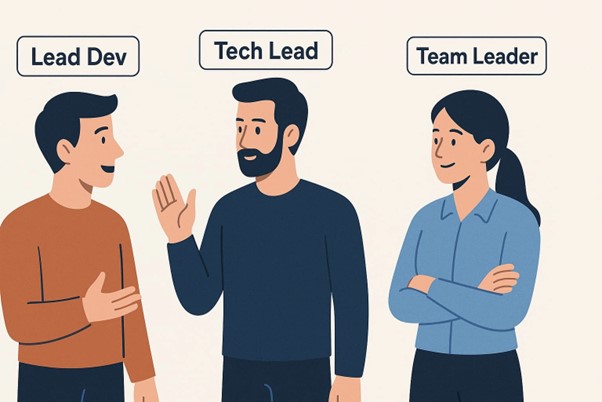
In many companies, you come across Lead Devs who structure the architecture, Tech Leads who supervise schedules, or even Team Leaders who review code during their lunch break.
It then becomes essential, as a first step, to establish clear definitions , role by role.
Lead Developer: technical lead and operational expert
The Lead Developer appears as the cornerstone of technical execution. He writes code, a lot of it. But not only that.
Its scope: to produce, optimize, and deliver . It ensures that the code remains robust, readable, and scalable. It oversees reviews, adherence to conventions, and CI/CD pipelines. It identifies faulty patterns, guides refactoring , and promotes best practices.
In parallel, he plays a mentoring role. He brings on board juniors , motivates mid-levels, and challenges seniors. His influence is not measured by the number of commits, but by the quality of technical knowledge transfer .
In terms of hierarchy, he remains firmly rooted in production. He doesn’t officially manage, even though he has influence. He collaborates closely with the Tech Lead, and sometimes the Product Owner. But his domain is the code.
Tech Lead: the cross-functional technical conductor

The Tech Lead doesn’t necessarily code more than others. Their role goes beyond the lines of code: they orchestrate everything.
He takes a step back. He structures the technical vision , aligns the architecture with product constraints, and draws up a realistic technical roadmap. He bridges the gap between technical debt and deadlines, between what we want to do and what needs to be delivered.
From then on, the Tech Lead becomes a permanent arbiter :
- performance vs scalability,
- robustness vs. velocity,
- Redesign vs. quick fix.
His decisions are not ideological. They are rooted in business reality, the backlog, and the field.
He holds a cross-functional position . He speaks with the Product Owner to advocate for technical projects. He challenges the QA team on testing strategies. He collaborates with DevOps to ensure reliable deployments. He works collaboratively with the team, without ever becoming its direct manager.
Team Leader: a team manager first and foremost
The Team Leader doesn’t always have a technical background, and that’s not a problem!
This position is similar to that of a line manager . Their role involves managing people , monitoring individual objectives, and ensuring team harmony. They organize regular meetings, monitor workload, and defuse tensions. They know how to set boundaries, but also how to listen, provide guidance, and offer support.
On the ground, he doesn’t make the technical decisions . He relies on the Lead Developer or the Tech Lead to arbitrate these issues. His contribution: aligning people, detecting early warning signs, and fostering a climate of trust.
Three roles, three DNAs: what each one really does
Skills: what each person uses on a daily basis
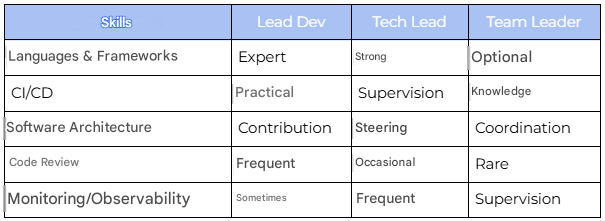
Each role requires a specific balance between pure technique, relational intelligence, and leadership posture.
Hard skills (techniques)
Soft skills (interpersonal skills)
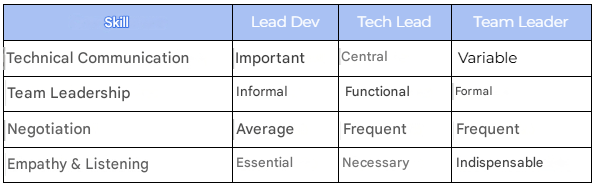
Note : all three roles are based on a hybrid foundation. None of them function without a minimum of empathy, rigor, and strategic perspective. What changes is the balance and the priority .
Deliverables and indicators: what does each role produce, and how do we evaluate it?

The deliverable is not always tangible. It is not limited to a pull request or a completed sprint. It can also take the form of successful onboarding, reduced debt, or controlled turnover .
Lead Dev: focus on operational quality
- Clean, optimized, testable code
- Reduction in blocking bugs
- Smoothness in merges/rebases
- Up-to-date technical documentation
- TDD and embedded best practices
Tech Lead: steering technical sustainability
- Maintainable and scalable architecture
- Technical debt under control (monitoring, reduction, prioritization)
- Effective onboarding techniques for new employees
- Measurable tech/product alignment
- Maintaining a consistent and rational stack
Team Leader: Human and organizational levers
- Perceived well-being of the team (via 1:1 surveys)
- Regular and structured feedback
- Reduction of interpersonal friction
- Monitoring skills development
- Contribution to annual evaluations
- Career interview preparation, HR follow-up
Each one delivers, but not to the same place. One feeds the delivery system, another the technical structure, and the third the human element.
A blurred line: where roles become entangled (and tensions explode)

Three tensions that are undermining tech teams
1️⃣ The blurring of boundaries
It all starts here. When roles are defined “on the fly”, when titles circulate without associated content, misunderstandings multiply .
A developer believes they depend on the Team Leader for their reviews. The Tech Lead thinks onboarding is an HR matter. The Product Owner consults the Lead Developer to make decisions.
And nobody is right, because nothing is defined.
2️⃣ The technical ego
Some positions attract misplaced egos. The Tech Lead who wants to impose their choices. The Lead Developer who refuses to be challenged. The Team Leader who overcompensates for their technical shortcomings by over-managing.
The power to say no or to approve becomes a status issue , instead of remaining a lever for collaboration.
3️⃣ Hierarchy/Influence Dissonance
A Lead Developer can influence an entire team, but not sign anything. A Team Leader can block a redesign without touching a single line of code.
Formal and informal authority overlap without dialogue. This invisible tension weakens the collective dynamic, ultimately disrupting the entire delivery process.
Clarifying roles: concrete methods and agile levers

Relying on proven models: RACI, DACI, Team Topologies
These tools offer precise analytical frameworks :
- RACI for mapping: who is responsible, who approves, who executes, who is consulted.
- DACI to clarify the arbitrations: one decision-maker, several contributors, but no ambiguity.
- Team Topologies to redesign teams according to their value streams, not their organizational chart.
These frameworks don’t solve everything, but they open up the discussion.
Focus on company culture
Methods are worthless without culture. An organization that values consensus, autonomy, or collective code review will not have the same expectations of a Tech Lead as a company focused on verticality and pure delivery.
Therefore, clarifying roles also means establishing explicit cultural norms , and making them a reality on a daily basis.
Co-write the role descriptions as a team
Rather than imposing a job description from a disconnected HR department, some teams co-create roles internally. They define them together:
- the boundaries of each perimeter,
- relays in case of conflict,
- shared autonomous zones.
This work has the merit of opening up a space for regular dialogue, where roles become alive, revisable, transparent.
FAQ
Can a junior employee become a Tech Lead?
No, and it’s not just a matter of experience.
The role of Tech Lead isn’t limited to writing clean code or knowing a tech stack. It involves making binding technical decisions , navigating technical debt, communicating with non-technical stakeholders, and advocating for trade-offs with product. In short, it’s about seeing beyond the sprint.
This requires perspective, technical legitimacy, and a form of natural authority . Qualities that cannot be developed in six months of bootcamp, nor on a single project.
On the other hand, a junior can very well aspire to this role in the medium term, if they start to get involved in architecture, to lead reviews , to challenge design choices in a constructive way.
Is the Tech Lead responsible in case of a major bug?
Responsible, yes. Guilty, no.
The Tech Lead bears a share of the responsibility for the technical strategy , including choices of tools, architecture , and processes. If a critical bug arises due to a botched (or ignored) decision, their role will inevitably be questioned.
But in the event of a bug due to human error in a commit, a missing test, or an oversight in production, the responsibility is collective . The Tech Lead is not a scapegoat.
His ability to react, to document the incident, to mobilize the team to understand the origin and prevent recurrences is a much better indicator of maturity than his willingness to point the finger at someone to blame.
Can you be a Lead Developer without providing supervision?
Yes. And it’s often even preferable.
The Lead Developer is not a manager . They do not evaluate performance, manage leave requests, or conduct HR interviews. Their influence is exerted through expertise, not hierarchy.
Some Lead Developers provide informal guidance: they mentor, guide, and review. But this remains technical leadership, not a managerial stance.
What is the difference between a Tech Lead and an Architect?
The architect designs the system. The Tech Lead implements it in reality.
The Architect takes a step back and looks at the entire platform: they define standards for architecture, scalability, and security. They often work across several teams and are interested in long-term technical sustainability.
The Tech Lead, on the other hand, remains closer to the code, the developers, and the product. They deal with deadlines, business priorities, the backlog, and dependencies. They make compromises, whereas the Architect thinks in terms of “optimal structure.”
Does the Team Leader need to code?
No. But he needs to understand what he doesn’t code.
A Team Leader will not be judged on their coding skills, but on their ability to manage a team of technical profiles . This implies speaking their language, understanding their constraints, and anticipating tensions related to technical choices… without necessarily intervening.
A former developer can leverage their background, provided they can put down the keyboard. A purely HR-oriented profile will need to compensate with active listening, business curiosity, and organizational humility.